
One of the most common (and least useful) debates in project management is Waterfall vs. Agile.
It’s often framed as a binary choice. In reality, experienced project managers know the truth:
It’s not about which is better — it’s about which fits the work.
Choosing the wrong approach doesn’t just slow you down—it creates rework, frustrates stakeholders, and undermines delivery confidence.
So how do you decide?
Let’s break it down.
When Waterfall Still Makes Sense
Traditional Waterfall works best when certainty is high and change is expensive.
Use Waterfall when:
- Requirements are well-defined and unlikely to change
- The project has regulatory or compliance constraints
- There are clear phase gates and approvals
- Dependencies are sequential and tightly coupled
- Stakeholders expect predictability over flexibility
Examples:
- Infrastructure upgrades
- Government or regulatory projects
- Data migrations with fixed scope
- Hardware implementations
Waterfall gives you control, documentation, and predictability—but at the cost of flexibility.
When Agile Wins
Agile methodologies like Scrum, Kanban, and Lean Six Sigma thrive in uncertainty and change.
Use Agile when:
- Requirements are evolving or unclear
- Stakeholders need frequent visibility and feedback
- You can deliver incremental value
- The team is cross-functional and collaborative
- Speed and adaptability are more important than predictability
Scrum
Best when you need:
- Structured iteration (sprints)
- Defined roles and ceremonies
- Regular delivery cycles
Kanban
Best when:
- Work is continuous (not sprint-based)
- You want to optimize flow and reduce bottlenecks
- Priorities shift frequently
Lean Six Sigma
Best when:
- You’re improving processes, not just delivering a product
- Reducing waste and variation is critical
- Data-driven decision-making is required
The Decision Matrix
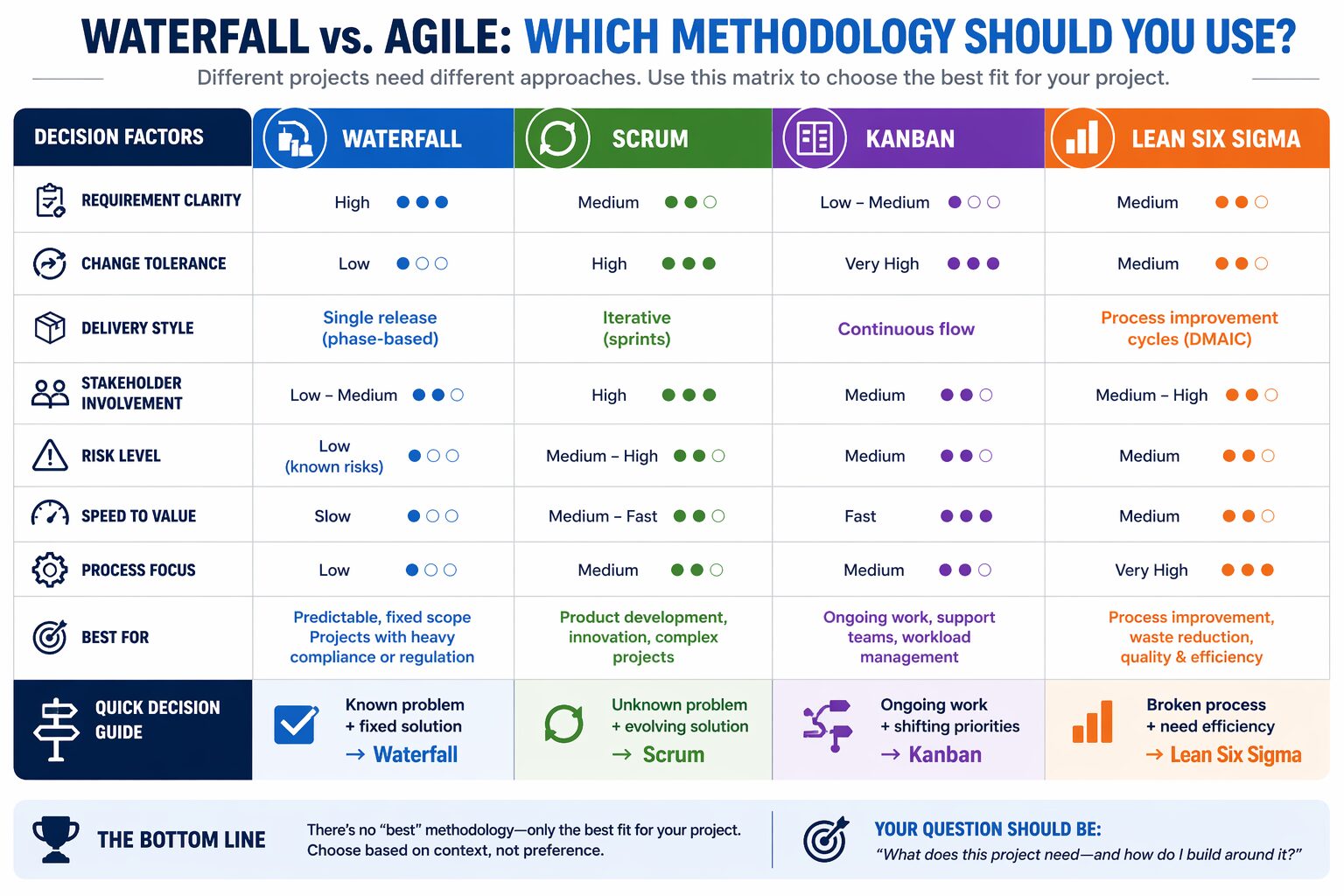
Here’s a practical way to choose your approach:
| Factor | Waterfall | Scrum | Kanban | Lean Six Sigma |
|---|---|---|---|---|
| Requirement Clarity | High | Medium | Low–Medium | Medium |
| Change Tolerance | Low | High | Very High | Medium |
| Delivery Style | Single release | Iterative (sprints) | Continuous flow | Process improvement cycles |
| Stakeholder Involvement | Low–Medium | High | Medium | Medium–High |
| Risk Level | Low (known risks) | Medium–High | Medium | Medium |
| Speed to Value | Slow | Medium–Fast | Fast | Medium |
| Process Focus | Low | Medium | Medium | Very High |
| Best For | Predictable, fixed scope | Product development | Operational work | Optimization & efficiency |
A Simpler Way to Decide (In Practice)
If you want a quick mental model:
- Known problem + fixed solution → Waterfall
- Unknown problem + evolving solution → Scrum
- Ongoing work + shifting priorities → Kanban
- Broken process + need efficiency → Lean Six Sigma
The Real Answer: Hybrid is the Norm
Most real-world projects don’t fit neatly into one box.High-performing teams often blend approaches:
- Waterfall for planning and governance
- Scrum for development
- Kanban for support and maintenance
- Lean Six Sigma for continuous improvement
This is where modern project managers differentiate themselves:
Not by following a framework—but by designing the right system.
One Last Thing…
Methodologies are tools—not identities.
If you find yourself defending one approach over another, you’re solving the wrong problem.
The real skill is asking:
“What does this project need to succeed—and how do I structure delivery to support that?”
That’s what separates good project managers from great ones.