
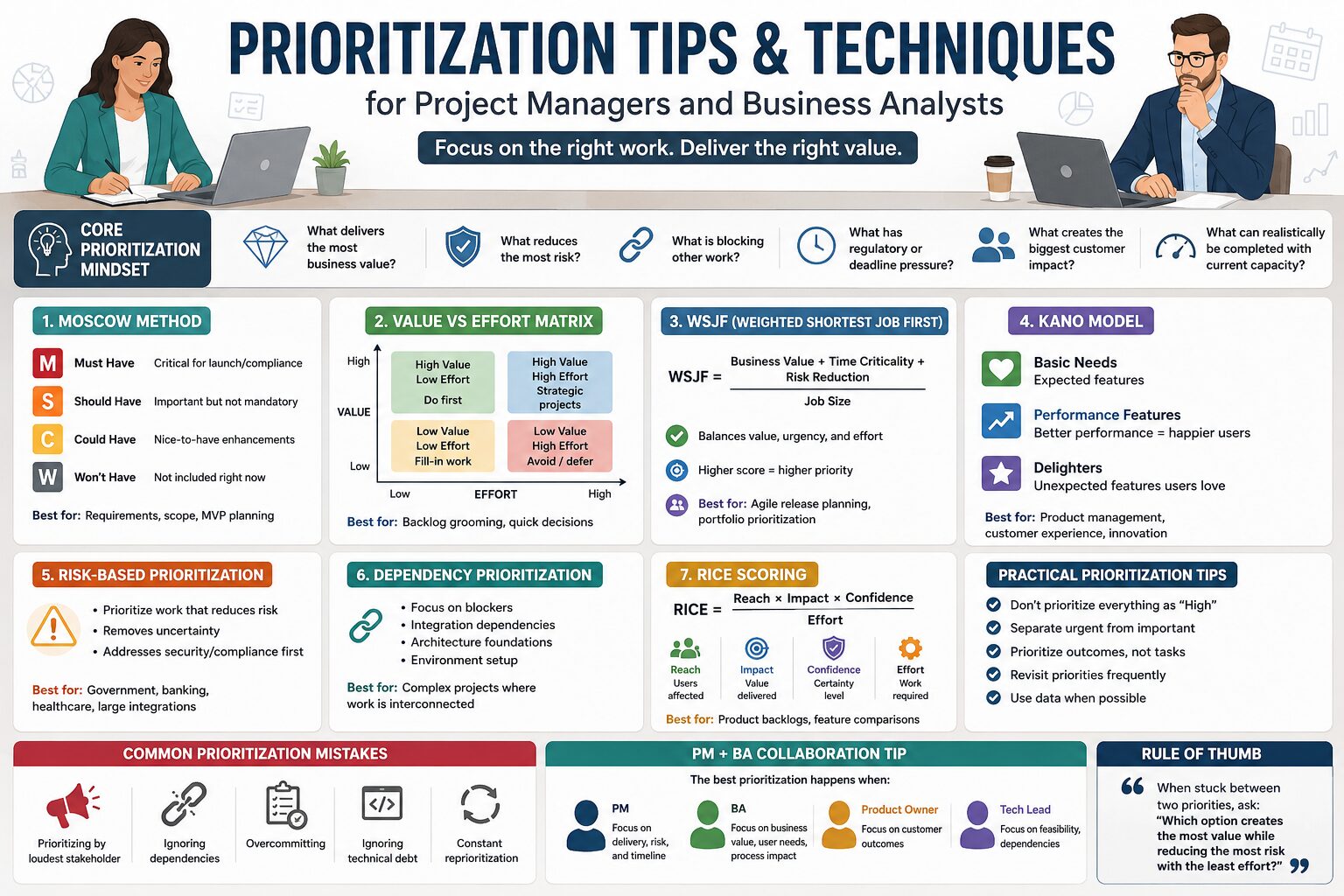
Have you ever heard “if everything is a priority, then nothing is?” Prioritization is one of the most important skills for both Project Managers and Business Analysts. Projects rarely fail because teams have nothing to do — they fail because teams work on the wrong things at the wrong time. Often just numbering tasks from 1 to n in order of importance isn’t the right method to use. Here are a few prioritization techniques to consider.
Core Prioritization Mindset
Before using any framework, start with these questions:
- What delivers the most business value?
- What reduces the most risk?
- What is blocking other work?
- What has regulatory or deadline pressure?
- What creates the biggest customer impact?
- What can realistically be completed with current capacity?
Good prioritization balances:
- Value
- Risk
- Effort
- Dependencies
- Timing
1. MoSCoW Method
One of the most common BA and Agile prioritization techniques.
Categories
| Priority | Meaning |
|---|---|
| Must Have | Critical for launch/compliance |
| Should Have | Important but not mandatory |
| Could Have | Nice-to-have enhancements |
| Won’t Have | Not included or not included right now |
Best Use Cases
- Requirements workshops
- Scope management
- MVP planning
- Stakeholder alignment
Example
For a banking app:
- Must: Login, account balance
- Should: Bill payments
- Could: Budget tracking
- Won’t: Cryptocurrency trading
2. Value vs Effort Matrix
Simple but powerful.
Plot work items based on:
- Business Value
- Effort/Complexity
Quadrants
| Quadrant | Action |
|---|---|
| High Value / Low Effort | Do first |
| High Value / High Effort | Strategic projects |
| Low Value / Low Effort | Fill-in work |
| Low Value / High Effort | Avoid/defer |
Best Use Cases
- Backlog grooming
- Quick decision-making
- Executive prioritization discussions
3. WSJF (Weighted Shortest Job First)
Popular in Agile and SAFe environments.
Formula:
Higher WSJF scores = higher priority.
Best Use Cases
- Agile release planning
- Portfolio prioritization
- Large enterprise programs
Why PMs Love It
It balances:
- Business impact
- Urgency
- Delivery effort
4. Kano Model
Focuses on customer satisfaction.
Categories
| Type | Description |
|---|---|
| Basic Needs | Expected features |
| Performance Features | Better performance = happier users |
| Delighters | Unexpected features users love |
Example
Streaming app:
- Basic: Video playback
- Performance: Faster loading
- Delighter: AI recommendations
Best Use Cases
- Product management
- Customer experience projects
- Innovation discussions
5. Risk-Based Prioritization
Prioritize work that:
- Reduces project risk
- Removes uncertainty
- Addresses security/compliance first
Example
Implement authentication/security before cosmetic UI improvements.
Best Use Cases
- Government projects
- Banking
- Healthcare
- Large integrations
6. Dependency Prioritization
Some tasks unlock other work.
Focus On:
- Blockers
- Integration dependencies
- Architecture foundations
- Environment setup
PM Tip
A small technical task may be more important than a flashy feature if 10 other tasks depend on it.
7. RICE Scoring
Common in product and Agile teams.
Formula:
Factors
- Reach = users affected
- Impact = value delivered
- Confidence = certainty level
- Effort = work required
Best Use Cases
- Product backlogs
- Feature comparisons
- Stakeholder debates
Practical Prioritization Tips
1. Don’t Prioritize Everything as “High”
If everything is urgent:
- Nothing is truly prioritized
- Teams burn out
- Delivery slows
Force ranking helps.
2. Separate Urgent from Important
Urgent:
- Production outage
- Regulatory deadline
Important:
- Technical debt
- Process improvement
- Long-term scalability
Great PMs balance both.
3. Prioritize Outcomes, Not Tasks
Instead of:
“Build reporting dashboard”
Focus on:
“Reduce executive reporting time from 5 hours to 30 minutes”
4. Revisit Priorities Frequently
Agile prioritization is continuous.
Things change because of:
- Stakeholder feedback
- Budget changes
- Risks
- Market conditions
- Technical discoveries
5. Use Data When Possible
Support prioritization with:
- Usage analytics
- Customer complaints
- Financial impact
- Risk scores
- Delivery metrics
Data reduces emotional decision-making.
Common Prioritization Mistakes
| Mistake | Result |
|---|---|
| Prioritizing by loudest stakeholder | Poor value delivery |
| Ignoring dependencies | Team bottlenecks |
| Over-committing | Missed deadlines |
| Ignoring technical debt | Slower future delivery |
| Constant reprioritization | Team confusion |
PM + BA Collaboration Tip
The best prioritization usually happens when:
- PM focuses on delivery/risk/timeline
- BA focuses on business value/user needs/process impact
- Product Owner focuses on customer outcomes
- Technical leads focus on feasibility/dependencies
Strong collaboration creates balanced decisions.
Simple Rule of Thumb
When stuck between two priorities, ask:
“Which option creates the most value while reducing the most risk with the least effort?”
That question alone solves a surprising number of prioritization debates.
