
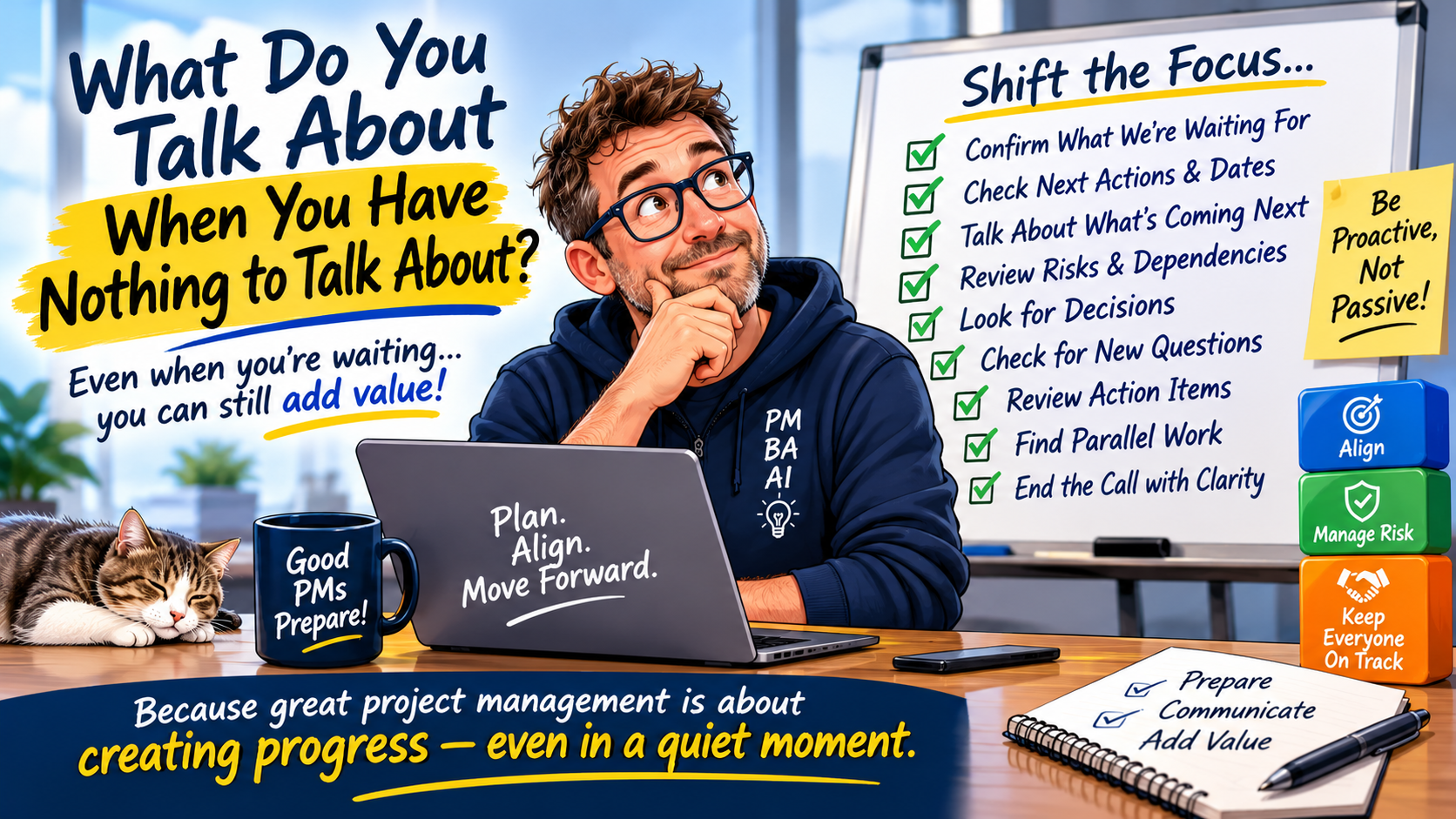
What Do You Talk About When You Have Nothing to Talk About?
What Project Managers can do when they’re waiting on developers, customers, vendors, or other team members
We’ve all been there.
You’re sitting in a project touchpoint or status call.
The customer asks:
“So, what’s the latest?”
You pause.
The developers are still working.
The analyst is waiting for an answer.
The customer hasn’t provided the data you need.
The vendor hasn’t responded.
And the testing team can’t start until something else is completed.
So you find yourself saying:
“Well… we’re still waiting.”
Awkward silence.
Then someone asks:
“Anything else?”
And you think:
“Nope. That’s pretty much it.”
But here’s the thing:
Being blocked doesn’t mean the Project Manager has nothing to do.
In fact, this is often when the PM’s work becomes even more important.
Don’t Confuse “No New Updates” With “No Progress”
One of the biggest mistakes we can make as Project Managers is thinking that every status call needs to contain exciting news.
It doesn’t.
Projects aren’t news broadcasts.
Sometimes the most accurate status is:
“There are no significant changes since our last update. The team is continuing to work on X, and we’re waiting for Y before we can move forward with Z.”
That’s perfectly acceptable.
The problem isn’t having no new information.
The problem is having no plan for what happens next.
So What Do You Talk About?
When the work is waiting on someone else, shift the conversation from:
“What has changed?”
to:
“What do we need to do to keep the project moving?”
Here are some areas I like to focus on.
1. Confirm What We’re Waiting For
Don’t simply say:
“We’re waiting on development.”
Be specific.
What are we waiting for?
- A completed development task?
- A technical decision?
- An environment?
- A code deployment?
- Test data?
- A response to a question?
- A resource?
- A customer decision?
The more specific you are, the easier it becomes to manage the dependency.
2. Confirm Who Owns the Next Action
This is a simple one, but it’s incredibly powerful.
Ask:
“Who has the next action?”
If the answer is:
“Development.”
Great.
Now ask:
“What’s the expected completion date?”
Now you have something you can manage.
Instead of:
“We’re waiting for development.”
You have:
“Development is completing the configuration, with an expected completion of Wednesday. Once complete, QA will begin testing.”
That’s a status update.
3. Talk About What’s Coming Next
Even if nothing is happening today, something should be coming next.
Talk about the next milestone.
For example:
Development → Testing → Training → Deployment
If development is currently underway, you can use the call to prepare for testing.
Ask:
- Are the testers ready?
- Do we have test data?
- Are test scripts available?
- Does the environment need to be prepared?
- Who needs access?
- What are the acceptance criteria?
- Are there any known risks?
You may not be able to move the current task forward.
But you can make sure you’re ready when it finishes.
4. Review Risks and Dependencies
This is where a PM can add real value.
If you’re waiting on someone, ask:
“What happens if this takes longer than expected?”
Maybe nothing.
Great.
But maybe it pushes testing.
Which pushes training.
Which pushes the customer go-live.
Now you have a potential schedule risk.
You don’t have to wait until the deadline is missed to talk about it.
A good PM is looking around the corner.
5. Use the Time to Make Decisions
Sometimes the project isn’t waiting for someone to do something.
It’s waiting for someone to decide something.
Those are different problems.
Ask:
“Are there any decisions we can make today that will help us when the work is ready?”
Maybe you need to decide:
- Which training approach to use
- Who will perform testing
- What data will be migrated
- Who needs access
- What the acceptance criteria are
- What happens if a requirement can’t be met
A 10-minute decision today can save days later.
6. Check for New Questions
A project can appear quiet while questions are quietly piling up.
Ask:
“Does anyone have questions or blockers that we haven’t captured?”
This gives people an opportunity to raise something that may not have made it into the status report.
Sometimes the most important information on a status call isn’t the update you expected.
It’s the problem someone finally mentions.
7. Review the Action Items
If you’re genuinely waiting, use the time to review open actions.
Not just:
“Any updates?”
Go one by one.
Action: Provide customer data
Owner: Customer
Due: November 3
Status: In progress
Action: Complete configuration
Owner: Development
Due: November 5
Status: In progress
Action: Prepare test scripts
Owner: QA
Due: November 6
Status: Ready
Now the meeting has structure.
And everyone knows what needs to happen next.
8. Talk About the Customer
Here’s another thing that can easily get forgotten.
While you’re waiting for one piece of work, ask:
“Is the customer ready for what’s coming next?”
Maybe development isn’t finished yet.
But perhaps the customer needs to:
- Review documentation
- Prepare users
- Clean up data
- Schedule training
- Confirm attendees
- Make a business decision
- Communicate upcoming changes
The project doesn’t have to stop just because one workstream is waiting.
Look for parallel work.
9. Don’t Manufacture Work Just to Fill the Call
This one is important.
Sometimes there really isn’t anything new to discuss.
And that’s okay.
You don’t need to fill 30 minutes because the calendar says 30 minutes.
If you’ve confirmed:
- Current status
- Next steps
- Owners
- Dates
- Risks
- Dependencies
- Decisions
- Customer readiness
then you may be done.
Say:
“It looks like we’re in a holding pattern until development completes. We have the next steps identified and no new risks at this point. Unless anyone has anything else to raise, I suggest we give everyone some time back.”
That’s not a bad meeting.
That’s a good Project Manager knowing when to end one.
The PM’s Job Isn’t to Create Updates
This is probably the most important lesson.
A Project Manager isn’t paid to make the project sound busy.
We’re there to help the project move toward its objective.
Sometimes that means driving.
Sometimes it means coordinating.
Sometimes it means solving problems.
And sometimes…
it means waiting.
But even when we’re waiting, we can still:
Prepare.
Communicate.
Identify risks.
Remove blockers.
Coordinate dependencies.
Make decisions.
Get the next phase ready.
That’s project management.
And This Is Where AI Can Help
This is also a great opportunity for AI.
Instead of spending your time manually reviewing everything before a status call, an AI assistant can help summarize:
- Outstanding action items
- Recent meeting notes
- Open risks
- Upcoming milestones
- Dependencies
- Items waiting on someone
- Decisions that haven’t been made
- Changes since the last status report
You could ask:
“Review the latest project notes and identify anything that needs attention on today’s status call. Separate the items into Updates, Decisions, Risks, Dependencies, and Actions.”
Now you aren’t walking into the meeting thinking:
“I have nothing to talk about.”
You’re walking in thinking:
“Here are the things we need to validate.”
AI doesn’t replace the PM’s judgment.
It helps the PM spend less time searching for information and more time using it.
The “Nothing to Talk About” Checklist
Before your next touchpoint, ask yourself:
STATUS
What’s changed since the last meeting?
ACTIONS
Who owes what?
DEPENDENCIES
What are we waiting on?
RISKS
What could affect the project?
DECISIONS
What needs someone to decide?
NEXT
What’s happening next?
READINESS
Can we prepare for the next phase while we’re waiting?
If you’ve covered those seven areas, you probably have plenty to talk about.
And if you don’t?
End the meeting.
Give people their time back.
One last thing…
Some of the best Project Managers I’ve worked with aren’t the ones who always have something impressive to say.
They’re the ones who can walk into a quiet project, understand exactly why it’s quiet, identify what needs to happen next, and keep everyone aligned while the work is happening behind the scenes.
Because sometimes project management isn’t about making things happen faster.
Sometimes it’s about making sure that when the waiting is over, everyone is ready to move.
And that’s still progress.

