
A few years ago, I decided I was going to take a proper vacation.
Not a “vacation” where I checked my email every morning.
Not a “vacation” where I opened Teams just to see what was happening.
And definitely not a “vacation” where I told myself, “I’ll just answer this one quick question.”
A real vacation.
I prepared my project handover notes. I updated my status reports. I made sure the team knew what was happening. I identified who would cover each project while I was away.
I had everything under control.
Then, somewhere between getting to the airport and finding my seat, I had the sudden urge to check my email.
I stopped myself.
Nope.
I was on vacation.
Twenty minutes later, I checked my email.
Apparently, Project Managers are very good at managing risks for everyone except themselves.
That experience taught me something important:
Taking time to recharge isn’t stepping away from your responsibilities. It’s part of being responsible.
After all, we spend our days managing schedules, risks, issues, dependencies, customers, stakeholders, resources, and expectations.
We should probably manage our own energy, too.
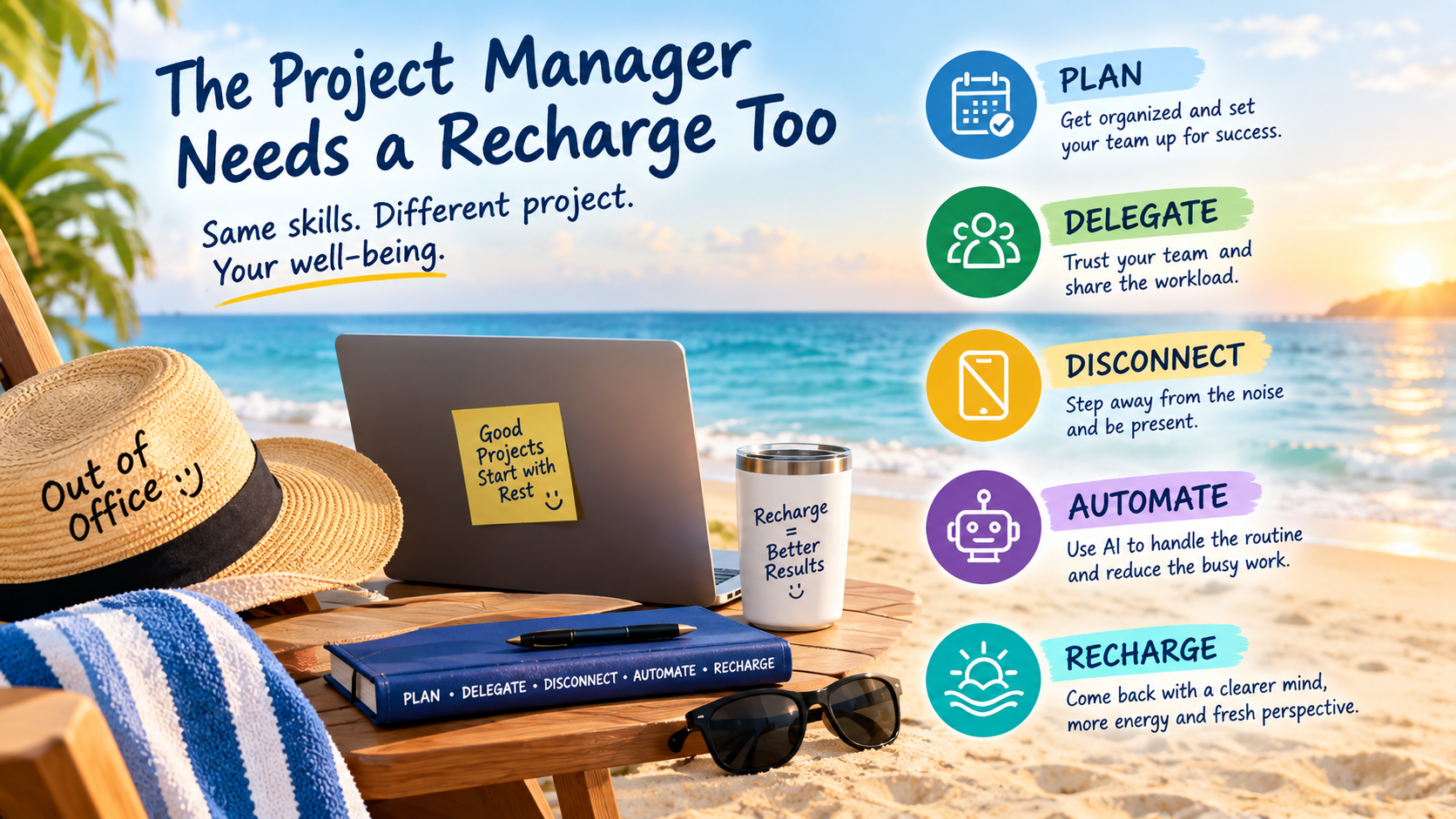
Here are five things I’ve learned about taking time to recharge as a Project Manager.
1. Plan Your Vacation Like You Plan a Project
This might be the most obvious—and possibly the most difficult—tip for a Project Manager.
We plan everything else.
Why wouldn’t we plan our time away?
Before you leave, identify:
- What needs to be completed before you go.
- What can wait until you return.
- What needs to be handed over.
- Who is responsible for what while you’re away.
- Which meetings need coverage.
- Which customers need to know you’re unavailable.
- What risks or issues need additional attention.
A good handover isn’t about documenting every single thing you’ve done.
It’s about giving the person covering for you enough information to make good decisions while you’re gone.
And there’s an important distinction here:
The goal isn’t to make your vacation productive. The goal is to make your absence manageable.
2. Don’t Confuse Being Available With Being Valuable
This one can be difficult for PMs.
We’re problem solvers.
When someone has a question, we want to help.
When something goes wrong, we want to fix it.
When a customer needs something, we want to respond.
But being constantly available doesn’t necessarily make us more valuable.
Sometimes the best thing we can do for our team is give them the opportunity to solve problems without us.
That doesn’t mean abandoning the project.
It means creating the right structure, assigning the right people, and trusting the team.
If everything requires the Project Manager to be available 24/7, perhaps the problem isn’t the vacation.
Perhaps the process needs some attention.
3. Actually Disconnect
This might be the hardest one.
Put the phone down.
Close Teams.
Stop checking email.
Resist the temptation to say:
“I’ll just take a quick look.”
Because we all know where that goes.
You check one email.
Then you see another.
Then you notice someone mentioned your project.
Then you think, “I should probably clarify that.”
And suddenly you’re sitting on a beach having a project status meeting with yourself.
Disconnecting doesn’t mean you don’t care about your work.
It means you understand that you are more than your inbox.
Give your brain permission to switch gears.
Go for a walk.
Spend time with family.
Read something that has absolutely nothing to do with project management.
Do something creative.
Or, if you’re anything like me, stare at the ocean and contemplate why someone thought a two-hour status meeting was necessary.
4. Use AI to Help You Prepare—Not to Keep You Working
This is where things get interesting.
As we bring AI into our workflows, we have an opportunity to use it to make time away easier.
AI can help with things like:
- Creating a draft project handover.
- Summarizing outstanding actions.
- Identifying upcoming milestones.
- Preparing a list of risks and issues.
- Drafting customer communications.
- Summarizing meetings.
- Creating a “what needs my attention when I return?” list.
- Organizing information for the person covering the project.
And, with appropriate controls, an AI agent could even help handle routine inquiries while you’re away.
But there’s an important principle here:
Don’t use AI to make yourself more available while you’re on vacation. Use AI to help make yourself less necessary for routine work.
That’s a very different mindset.
The goal isn’t:
“How can AI help me answer emails while I’m sitting on the deck?”
The goal is:
“How can AI help make sure I don’t need to answer those emails at all?”
That’s where AI process transformation becomes really interesting.
5. Come Back Recharged—Not Just Caught Up
There’s another trap that Project Managers can fall into.
We spend the entire vacation thinking about what we’ll have to deal with when we return.
Then we come back and immediately try to catch up on everything.
Two hundred emails.
Twenty Teams messages.
Three meetings that were scheduled before you returned.
And at least one person saying:
“Welcome back! I have a quick question.”
Your first day back shouldn’t be a race to recreate the last week.
Build some recovery time into your return.
Review your projects.
Look at what changed.
Reconnect with your team.
Prioritize.
Then start moving.
You don’t need to solve everything on the first morning.
Remember, you left the projects in capable hands. Trust the process you put in place.
Recharge Is Part of the Job
Project Management is often described as managing scope, schedule, cost, quality, risk, resources, and stakeholders.
But there’s another resource we don’t talk about enough:
Us.
Our attention.
Our energy.
Our creativity.
Our ability to make good decisions.
Those resources aren’t unlimited.
And just like a project budget, they need to be managed.
Taking time to recharge isn’t a sign that you’re less committed to your work.
It can actually make you better at it.
You come back with a clearer head.
You have more patience.
You think differently.
You see problems from another perspective.
And sometimes, stepping away from a problem is exactly what allows you to see the solution.
So the next time you’re planning vacation, don’t just ask:
“What do I need to get done before I leave?”
Also ask:
“What do I need to do so I can genuinely step away?”
Because the best Project Managers don’t just know how to keep projects moving.
They know when it’s time to stop, recharge, and come back ready for the next one.
And if you happen to check your email from the beach…
Well…
I won’t tell anyone.
But your Out-of-Office AI Agent might.
P.S. OOO PM framework: PLAN → DELEGATE → DISCONNECT → AUTOMATE → RECHARGE

