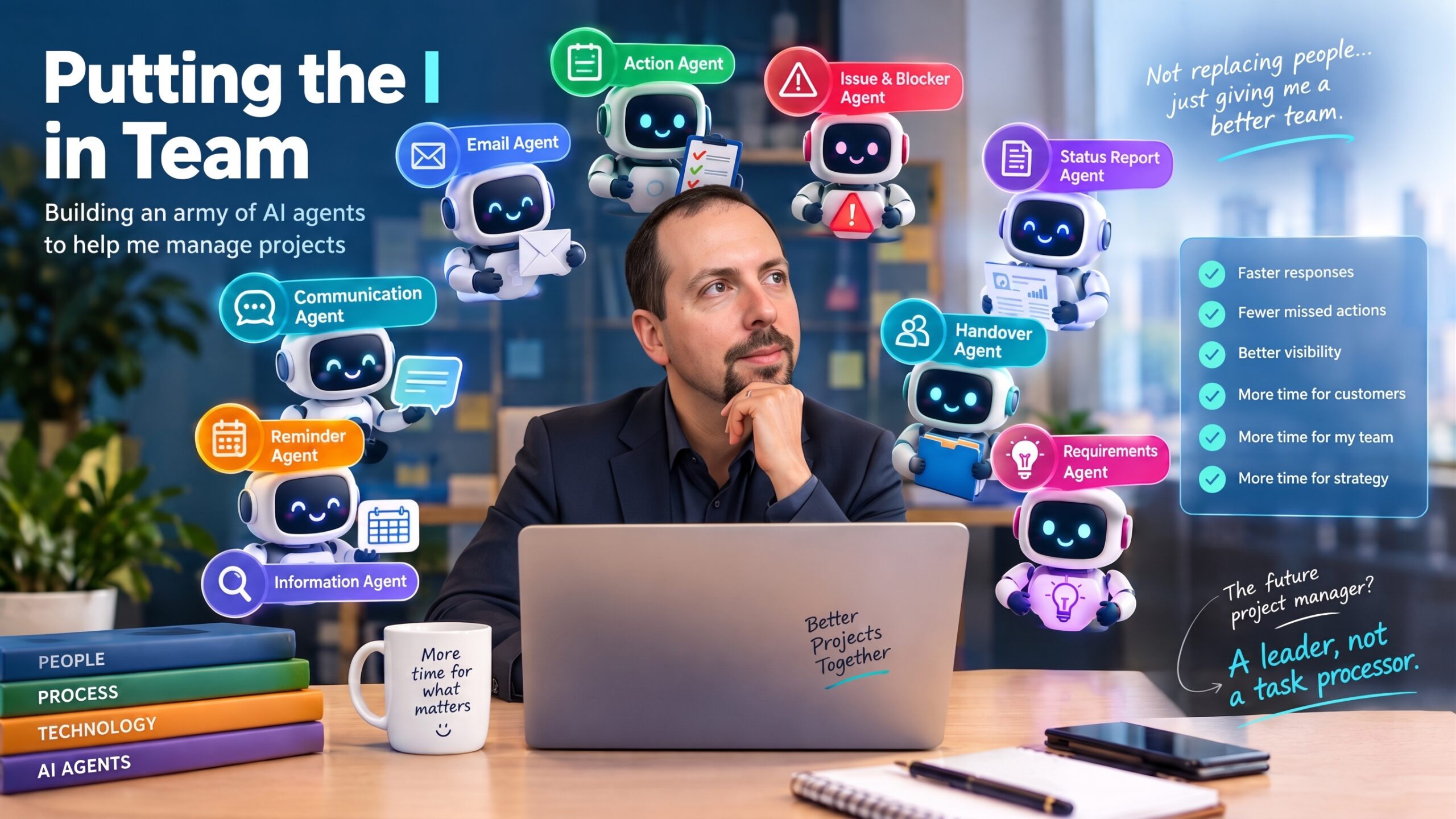
Building an army of AI agents to help me manage projects
There is an old saying:
“There is no I in team.”
I understand the sentiment.
Project management is a team sport. We work with customers, developers, analysts, testers, trainers, vendors, executives, and countless other people to get things done.
But I think there is another way to look at it.
With the right use of Artificial Intelligence, there can be an “I” in team.
Not because I want to do everything myself.
Quite the opposite.
I want to build a team around me.
An AI team.
And I’m not talking about one giant AI tool that magically manages my projects.
I’m talking about creating an army of specialized AI agents and workflows, each with a specific job.
Think of them as my digital project-management assistants.
The Project Manager’s Day Starts Before the First Meeting
Most project managers don’t start their day by opening their project plan and calmly reviewing the day’s priorities.
We open Outlook.
And then we see it.
47 unread emails.
Some are important.
Some aren’t.
Some require action.
Some are simply information.
Some contain a question from a customer.
Some contain a request from three days ago that somehow got buried.
And somewhere in that inbox is probably an email that says:
“Just following up on this…”
That’s where my AI team starts working.
The Morning Email Agent
One of my AI agents can review my unread emails and help answer questions like:
- What came in overnight?
- Which emails require my attention?
- Are there customer requests?
- Are there action items?
- Did someone assign me a task?
- Are there follow-ups I need to complete?
- Are there deadlines?
- Did someone ask a question that hasn’t been answered?
- Are there issues or blockers?
- Are there special requests I need to remember?
Instead of spending the first hour digging through my inbox, I can start with a prioritized picture of what needs my attention.
The AI isn’t making the decisions for me.
It’s helping me find the decisions.
Then I Start Building the Team
This is where things get interesting.
Rather than asking one AI assistant to do everything, I’m looking at individual tasks and asking:
“Could an agent do this?”
If the answer is yes, I start designing the workflow.
For example:
📧 Email Agent
Finds important emails, action items, questions, requests, and follow-ups.
📋 Action-Item Agent
Looks across emails and meeting information to identify commitments and outstanding tasks.
🚦 Issue & Blocker Agent
Looks for project risks, issues, dependencies, and blockers that may require attention.
📝 Status Report Agent
Pulls together project information and creates a first draft of my weekly status report.
✉️ Email Assistant
Creates a first draft of customer updates, follow-ups, meeting invitations, reminders, and other communications.
🏖️ Handover Agent
Helps create project handover notes before vacation or time away.
🔍 Requirements Agent
Reviews conversations, emails, notes, and documentation to identify potential business or project requirements.
⏰ Reminder Agent
Identifies commitments and important dates and helps ensure they don’t disappear into the inbox.
📚 Information Agent
Retrieves information from the systems where project information lives.
And that’s just the beginning.
The Information Problem
One of the biggest challenges for a project manager isn’t necessarily a lack of information.
It’s finding the right information.
Today’s projects can have information scattered everywhere:
- Outlook
- Microsoft Teams
- Salesforce
- SharePoint
- Confluence
- Project management systems
- Documents
- Spreadsheets
- Meeting notes
- Emails
- Customer communications
The information exists.
The challenge is getting the right information, to the right person, at the right time.
That’s where AI agents and workflows can become incredibly powerful.
Imagine asking:
“What is the current status of Project ABC?”
And having an AI workflow retrieve relevant information from the approved project sources and help assemble the answer.
Or:
“What outstanding actions do I have for this project?”
Or:
“What did the customer request during our last few meetings?”
Or:
“Are there any unresolved blockers?”
Or:
“What information do I need before tomorrow’s customer meeting?”
Instead of becoming a human search engine, I can focus on being the project manager.
My AI Team Doesn’t Replace Me
This is probably the most important part.
I’m not building these agents because I want AI to become the project manager.
I’m building them because I want to become a better project manager.
There is a huge difference.
AI can help gather information.
It can summarize.
It can identify patterns.
It can draft.
It can remind.
It can organize.
It can retrieve.
It can prepare.
But I still need to apply:
Judgment.
Experience.
Leadership.
Empathy.
Communication.
Critical thinking.
Decision-making.
That’s the human part of project management.
And that’s the part I want to spend more time doing.
From AI Assistant to AI Team
I think this is where the future of knowledge work is heading.
We have spent years thinking about AI as an assistant.
“Ask AI a question.”
“Have AI write something.”
“Use AI to summarize this.”
That’s useful.
But I think the next step is bigger.
Don’t just ask AI to do a task.
Build a workflow around the task.
Then ask:
“Can this happen automatically?”
That’s the difference between using AI occasionally and actually engineering AI into the way you work.
My Army of Agents
I’m beginning to think of my AI workflows almost like a project team.
Each agent has:
- A specific responsibility
- A defined purpose
- Inputs
- Rules
- Instructions
- Expected outputs
- Boundaries
- Human oversight
Sound familiar?
It should.
That’s project management.
We’re essentially applying the same principles we use to manage people and processes to managing AI.
Define the objective.
Define the inputs.
Define the process.
Define the output.
Define the controls.
Define who makes the final decision.
That’s where the “I” in team comes in.
I’m not working alone.
I’m working with a team of digital agents.
The 20% Goal
For me, this isn’t about saying:
“Look how much AI can do.”
That’s not the goal.
The goal is much simpler.
Can I reclaim 20% of my time?
If an agent can save me 15 minutes every morning, that’s valuable.
If another saves me an hour preparing a status report, that’s valuable.
If another helps me find information in seconds instead of searching through five systems, that’s valuable.
If another catches an action item that I might otherwise miss, that’s valuable.
Those minutes add up.
And the time I get back can be invested in the things that actually require me.
Talking to customers.
Helping my team.
Solving problems.
Managing expectations.
Removing blockers.
Thinking strategically.
Building relationships.
Leading.
The PM of the Future
I don’t believe the future project manager is going to be someone who competes with AI.
I think the future project manager will be someone who knows how to work with AI.
They won’t necessarily have one AI assistant.
They may have dozens of specialized agents working behind the scenes.
One watching the inbox.
One preparing reports.
One monitoring actions.
One analyzing requirements.
One tracking issues.
One preparing meetings.
One organizing information.
One helping with communications.
And potentially an orchestration workflow coordinating all of them.
The PM becomes less of a human task processor and more of a leader, decision-maker, strategist, and orchestrator.
There Is Still a Human in the Loop
And that matters.
I don’t want an AI agent sending an important customer email without appropriate oversight.
I don’t want an AI deciding that a project is healthy simply because a spreadsheet says everything is green.
I don’t want AI inventing requirements.
I don’t want AI making commitments on my behalf.
And I definitely don’t want to blindly trust an AI-generated status report.
AI is only as good as the information, instructions, context, and controls surrounding it.
That’s why the human remains in the loop.
The agents can prepare.
I decide.
The agents can identify.
I validate.
The agents can recommend.
I choose.
The agents can automate.
I remain accountable.
So, Is There an “I” in Team?
Maybe there isn’t in the traditional sense.
But I think there can be an “I” in an AI-powered team.
The “I” isn’t about doing everything myself.
It’s about creating the right team around me.
And that team may include people, technology, automation, workflows, and AI agents.
The exciting part is that I’m not waiting for someone to build this future for me.
I’m experimenting with building it myself.
One workflow at a time.
One agent at a time.
One time-saver at a time.
Because the objective isn’t to have an army of AI agents just for the sake of having an army.
The objective is simple:
Reclaim my time.
Focus on higher-value work.
Become a better project manager.
And ultimately…
Get more done without working harder.
Maybe there is an “I” in team after all.
It’s just that today… the “I” stands for Intelligence.