
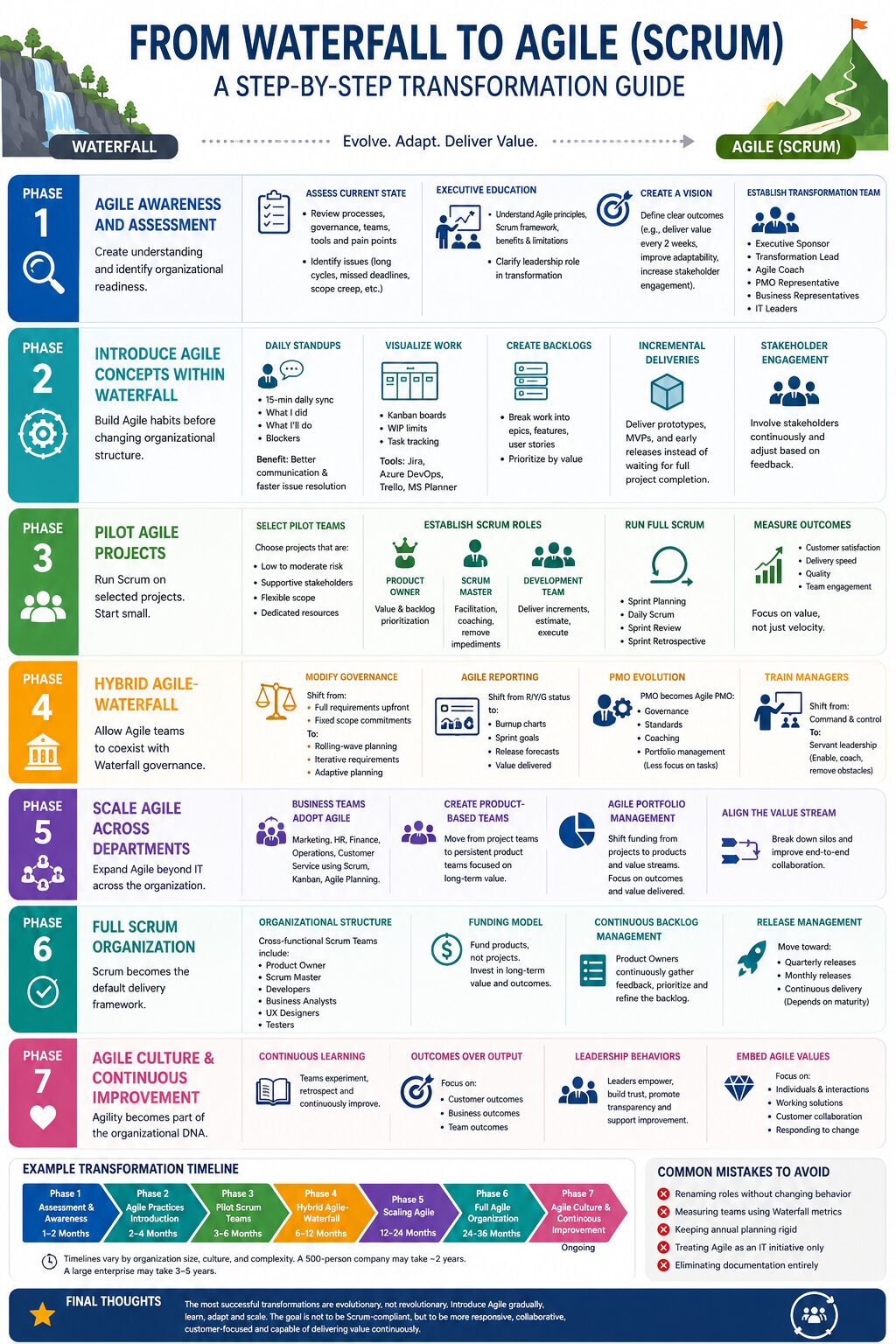
Many organizations make the mistake of trying to become Agile overnight. They send employees to Scrum training, rename Project Managers to Scrum Masters, and expect immediate results.
Successful Agile transformations rarely happen that way.
Organizations that transition successfully typically evolve through several stages, gradually introducing Agile principles, practices, roles, and governance while continuing to deliver business value.
This guide outlines a phased approach that allows organizations to reduce risk, build confidence, and create sustainable change.
Why Organizations Struggle with Agile Transformations
Before discussing the roadmap, it’s important to understand the common reasons Agile transformations fail:
- Trying to change everything at once
- Lack of executive support
- Keeping old governance while expecting Agile outcomes
- Measuring Agile teams using Waterfall metrics
- Focusing on ceremonies instead of mindset
- Lack of Product Ownership
- Resistance from middle management
- Insufficient coaching and training
Agile is not simply a new process.
It is a different way of thinking about planning, delivery, collaboration, and customer value.
Phase 1: Agile Awareness and Assessment
Goal
Create understanding and identify organizational readiness.
Activities
Assess Current State
Review:
- Project delivery processes
- Governance structures
- PMO practices
- Team structures
- Stakeholder engagement
- Current pain points
Identify issues such as:
- Long delivery cycles
- Frequent missed deadlines
- Scope creep
- Customer dissatisfaction
- Excessive documentation
- Slow decision-making
Executive Education
Leadership must understand:
- Agile principles
- Scrum framework
- Benefits and limitations
- Their role in transformation
Executives should understand that Agile:
- Does not eliminate planning
- Does not remove accountability
- Does not mean “no documentation”
Create a Transformation Vision
Examples:
Deliver value every 2 weeks instead of every 6 months.
Increase stakeholder engagement throughout delivery.
Improve adaptability to changing business priorities.
Establish Transformation Team
Create a team consisting of:
- Executive Sponsor
- Transformation Lead
- Agile Coach
- PMO Representative
- Business Representatives
- IT Leaders
Phase 2: Introduce Agile Concepts Within Waterfall
Goal
Build Agile habits before changing organizational structure.
At this stage, projects remain Waterfall but begin adopting Agile practices.
Introduce Daily Standups
Teams begin meeting daily:
Questions:
- What did I complete?
- What am I working on?
- What blockers exist?
Benefits:
- Improved communication
- Faster issue resolution
- Increased visibility
Visualize Work
Implement:
- Kanban Boards
- Task Boards
- Work-in-progress tracking
Tools:
- Jira
- Azure DevOps
- Trello
- MS Planner
Focus on transparency.
Create Product Backlogs
Instead of large requirements documents:
Begin organizing work into:
- Features
- Epics
- User Stories
Example:
Instead of:
“Build Customer Portal”
Create:
- Customer login
- Password reset
- Profile update
- Document upload
This introduces backlog thinking.
Incremental Deliveries
Rather than waiting for full project completion:
Deliver:
- Prototypes
- MVPs
- Early releases
Stakeholders begin seeing value sooner.
Phase 3: Pilot Agile Projects
Goal
Run Scrum on selected projects.
Do not transform the entire company.
Start small.
Select Pilot Teams
Choose projects that:
- Have manageable risk
- Supportive stakeholders
- Flexible scope
- Dedicated resources
Avoid:
- Highly regulated initiatives
- Mission-critical programs
- Projects with fixed contractual requirements
Establish Scrum Roles
Product Owner
Responsible for:
- Backlog prioritization
- Business value
- Stakeholder engagement
Scrum Master
Responsible for:
- Facilitation
- Coaching
- Removing impediments
Development Team
Responsible for:
- Delivering increments
- Estimation
- Technical execution
Run Full Scrum
Introduce:
Sprint Planning
Determine:
- Sprint Goal
- Sprint Backlog
Daily Scrum
15-minute synchronization meeting.
Sprint Review
Demonstrate completed work.
Sprint Retrospective
Improve team performance.
Measure Outcomes
Track:
- Customer satisfaction
- Delivery speed
- Quality
- Team engagement
Do not focus solely on velocity.
Phase 4: Hybrid Agile-Waterfall
Goal
Allow Agile teams to coexist with Waterfall governance.
Most organizations spend significant time here.
Modify Governance
Instead of requiring:
- Full requirements upfront
- Fixed scope commitments
Allow:
- Rolling-wave planning
- Iterative requirements
- Backlog refinement
Agile Reporting
Move from:
Red/Yellow/Green status reports
To:
- Burnup charts
- Sprint goals
- Release forecasts
- Value delivered
PMO Evolution
Traditional PMO responsibilities shift toward:
Agile PMO
Focus on:
- Governance
- Coaching
- Standards
- Portfolio management
Less focus on:
- Detailed task management
Train Managers
Managers shift from:
Command-and-control leadership
To:
Servant leadership
Responsibilities become:
- Coaching
- Enabling
- Removing obstacles
Phase 5: Scale Agile Across Departments
Goal
Expand Agile beyond IT.
Agile should involve the entire value stream.
Business Teams Adopt Agile
Departments may include:
- Marketing
- HR
- Finance
- Operations
- Customer Service
Using:
- Kanban
- Scrum
- Agile Planning
Create Product-Based Teams
Move away from:
Project Teams
Toward:
Persistent Product Teams
Traditional:
Project starts → Team forms → Team disbands
Agile:
Product exists → Team remains
Benefits:
- Better knowledge retention
- Faster delivery
- Increased accountability
Implement Agile Portfolio Management
Funding shifts from:
Projects
To:
Products and Value Streams
Questions become:
- What value are we delivering?
- What outcomes are we achieving?
Instead of:
- Are we on budget?
- Are we on schedule?
Phase 6: Full Scrum Organization
Goal
Scrum becomes the default delivery framework.
Organizational Structure
Teams consist of:
- Product Owner
- Scrum Master
- Developers
- Business Analysts
- UX Designers
- Testers
All working as one Scrum Team.
Funding Model Changes
Funding supports:
Products
Not temporary projects.
Continuous Backlog Management
Product Owners continuously:
- Gather feedback
- Prioritize work
- Refine backlog
Planning becomes continuous.
Release Management
Instead of large annual releases:
Organizations move toward:
- Quarterly releases
- Monthly releases
- Continuous deployment
Depending on maturity.
Phase 7: Agile Culture and Continuous Improvement
Goal
Agility becomes part of organizational DNA.
At this point Agile is no longer a process.
It becomes culture.
Continuous Learning
Teams regularly:
- Experiment
- Retrospect
- Improve
Metrics Focus on Outcomes
Measure:
Customer Outcomes
- Satisfaction
- Adoption
- Retention
Business Outcomes
- Revenue
- Cost savings
- Market share
Team Outcomes
- Engagement
- Predictability
- Quality
Leadership Behaviors
Leaders focus on:
- Empowerment
- Transparency
- Trust
- Continuous improvement
Rather than:
- Command and control
- Detailed oversight
Example Transformation Timeline
| Phase | Duration |
|---|---|
| Assessment & Awareness | 1-2 Months |
| Agile Practices Introduction | 2-4 Months |
| Pilot Scrum Teams | 3-6 Months |
| Hybrid Agile-Waterfall | 6-12 Months |
| Scaling Agile | 12-24 Months |
| Full Agile Organization | 24-36 Months |
Every organization moves at a different pace.
A 500-person company may take 2 years.
A large enterprise may take 3-5 years.
Common Mistakes to Avoid
Mistake #1: Renaming Roles Without Changing Behavior
Project Manager ≠ Scrum Master
Manager ≠ Product Owner
Role changes require mindset changes.
Mistake #2: Measuring Teams Using Waterfall Metrics
Avoid:
- Percent complete
- Tasks completed
- Hours worked
Focus on value delivered.
Mistake #3: Keeping Annual Planning Rigid
Agile requires adaptability.
Plans should evolve.
Mistake #4: Treating Agile as an IT Initiative
Agile transformation is an organizational change initiative.
Not a software development methodology rollout.
Mistake #5: Eliminating Documentation Entirely
Agile values:
“Working software over comprehensive documentation”
It does not say:
“No documentation.”
Document what provides value.
One Last Thing…
The most successful Agile transformations are evolutionary rather than revolutionary.
Organizations that gradually introduce Agile practices, pilot Scrum teams, adapt governance, and scale lessons learned typically achieve far better results than those attempting a company-wide “big bang” transformation- and expect immediate results.
The objective is not to become Scrum-compliant.
The objective is to become more responsive, collaborative, customer-focused, and capable of delivering value continuously.
When done correctly, Scrum becomes more than a framework—it becomes the operating model through which the organization plans, delivers, learns, and improves.