
Let’s be honest, taking a vacation as a Project Manager can feel stressful.
Even when you’ve earned the time off, there’s often that lingering thought:
“What if something goes wrong while I’m away?”
Projects don’t stop because we’re on vacation.
Customers still have questions.
Status meetings still happen.
Risks still emerge.
Action items still need owners.
But here’s something I’ve learned over the years:
A successful vacation starts with a successful handover.
If your project depends entirely on you being available every day, the project has a bigger problem than your upcoming vacation.
Start Planning Before You Pack
One of the biggest mistakes project managers make is waiting until the day before vacation to think about their handover.
The best transitions begin one to two weeks in advance.
This gives you time to update documentation, brief your backup, resolve outstanding issues, and communicate with stakeholders.
A rushed handover often creates more work than it saves.
Create a “Project at a Glance”
Your backup shouldn’t have to dig through emails or meeting notes to understand the project.
Create a simple summary that includes:
- Overall project status
- Current phase
- Key milestones
- Upcoming deadlines
- Project health (Green, Yellow, or Red)
- Major risks and issues
- Important customer contacts
- Internal team members and responsibilities
Think of this as the first page someone reads if they know nothing about your project.
Document Outstanding Action Items
Not every task needs detailed instructions.
But every outstanding action item should answer four simple questions:
- What needs to be done?
- Who owns it?
- When is it due?
- What happens if it’s delayed?
This prevents your backup from spending valuable time trying to understand unfinished work.
Prepare Your Meeting Notes
If regular project meetings will continue while you’re away, make life easier for the person covering for you.
Provide:
- Meeting schedules
- Agendas
- Current discussion topics
- Decisions already made
- Questions that still need answers
- Expected outcomes
A little context goes a long way.
Don’t Forget Status Reports
Many organizations have weekly customer or executive status reports.
Instead of asking your backup to create one from scratch, prepare a template before you leave.
Include:
- Current accomplishments
- Work completed
- Upcoming milestones
- Risks
- Issues requiring attention
- Decisions needed
- Project metrics
Leave clear instructions on what should be updated during your absence.
Consistency builds confidence with stakeholders.
Introduce Your Backup to the Customer
One of the simplest but most overlooked steps is making a proper introduction.
Don’t let your customer discover you’re away through an automatic email reply.
Schedule a quick meeting or send an introduction email before you leave.
Explain:
- Who will be covering the project
- What decisions they can make
- How to contact them
- When you’ll return
This small step builds trust and reassures the customer that the project remains in good hands.
Expect the Unexpected
Even the best handovers can’t predict everything.
That’s okay.
Leave guidance instead of trying to document every possible scenario.
For example:
“If it’s a schedule change, speak with the technical lead before responding.”
“If it’s a scope request, document it and review it after I return.”
“If it’s a production issue, follow the standard escalation process.”
Decision-making frameworks are often more valuable than detailed instructions.
Resist the Urge to Check In Constantly
Vacation exists for a reason.
Your team grows when they’re trusted to lead.
Your backup gains valuable experience.
Your customer learns the project isn’t dependent on one person.
Unless there’s a true emergency, disconnect.
You’ll return with more energy, better perspective, and a stronger team.
The Best Vacation Is the One Your Team Can Handle Without You
One of the greatest compliments a project manager can receive isn’t hearing:
“We couldn’t do anything while you were away.”
It’s hearing:
“Everything went smoothly. Enjoy your vacation.”
That’s a sign of strong leadership.
It means you’ve built clear processes.
You’ve shared knowledge.
You’ve empowered your team.
And you’ve created a project that can continue moving forward—even when you’re taking a well-deserved break.
Because great project managers don’t prove their value by always being available.
They prove their value by building teams and projects that continue to succeed, even in their absence.
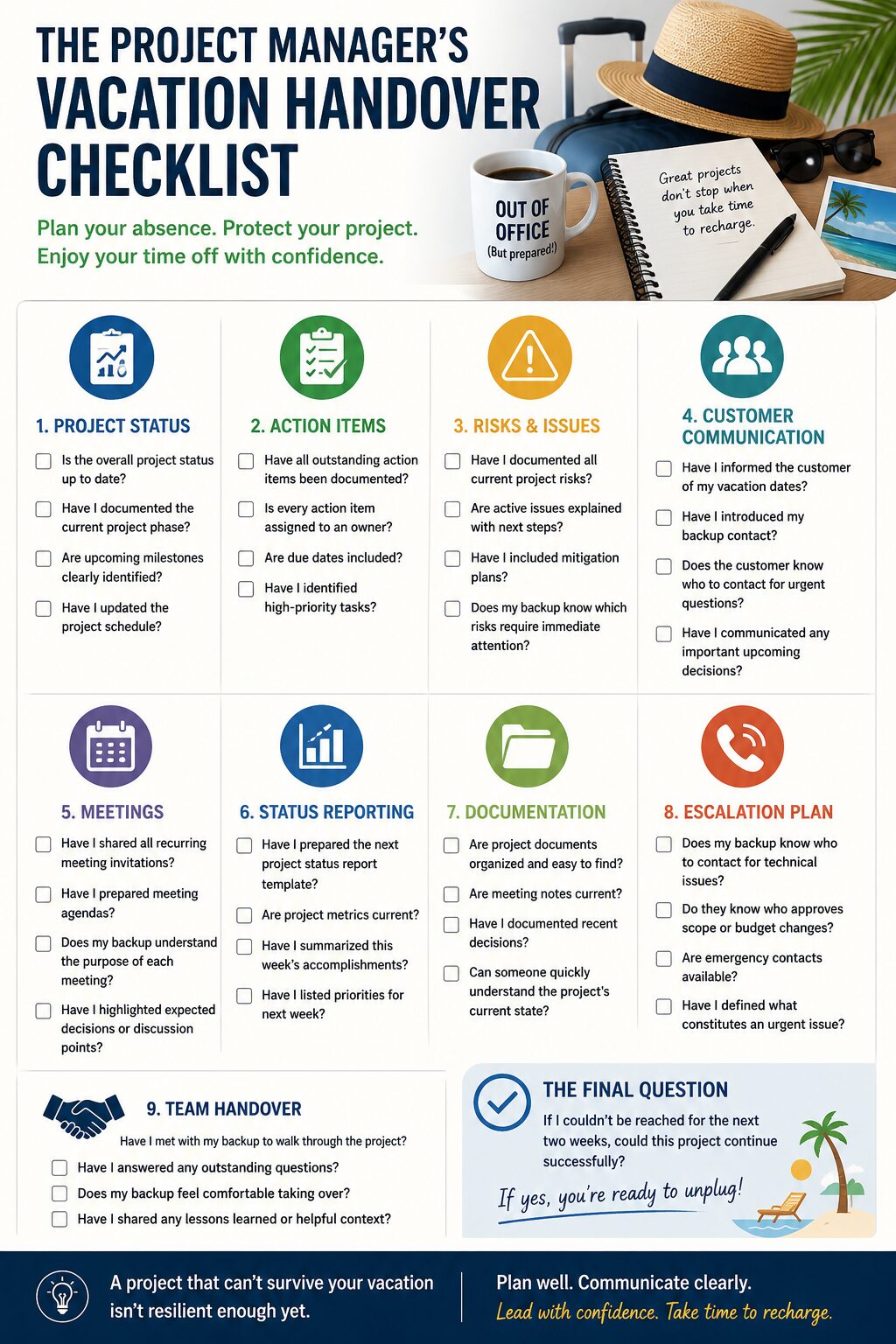
Before You Leave: A Vacation Handover Checklist
Before you close your laptop, ask yourself:
✔ Is my project summary up to date?
✔ Have I documented all open action items?
✔ Does my backup know the project priorities?
✔ Are meeting agendas and schedules available?
✔ Is the next status report prepared or templated?
✔ Have I introduced my backup to the customer?
✔ Does everyone know who to contact while I’m away?
✔ Have I shared key risks, decisions, and escalation paths?
If you can answer “yes” to each of these, you’re ready to unplug with confidence.
After all, taking time to recharge isn’t stepping away from your responsibilities—it’s part of being an effective leader.