
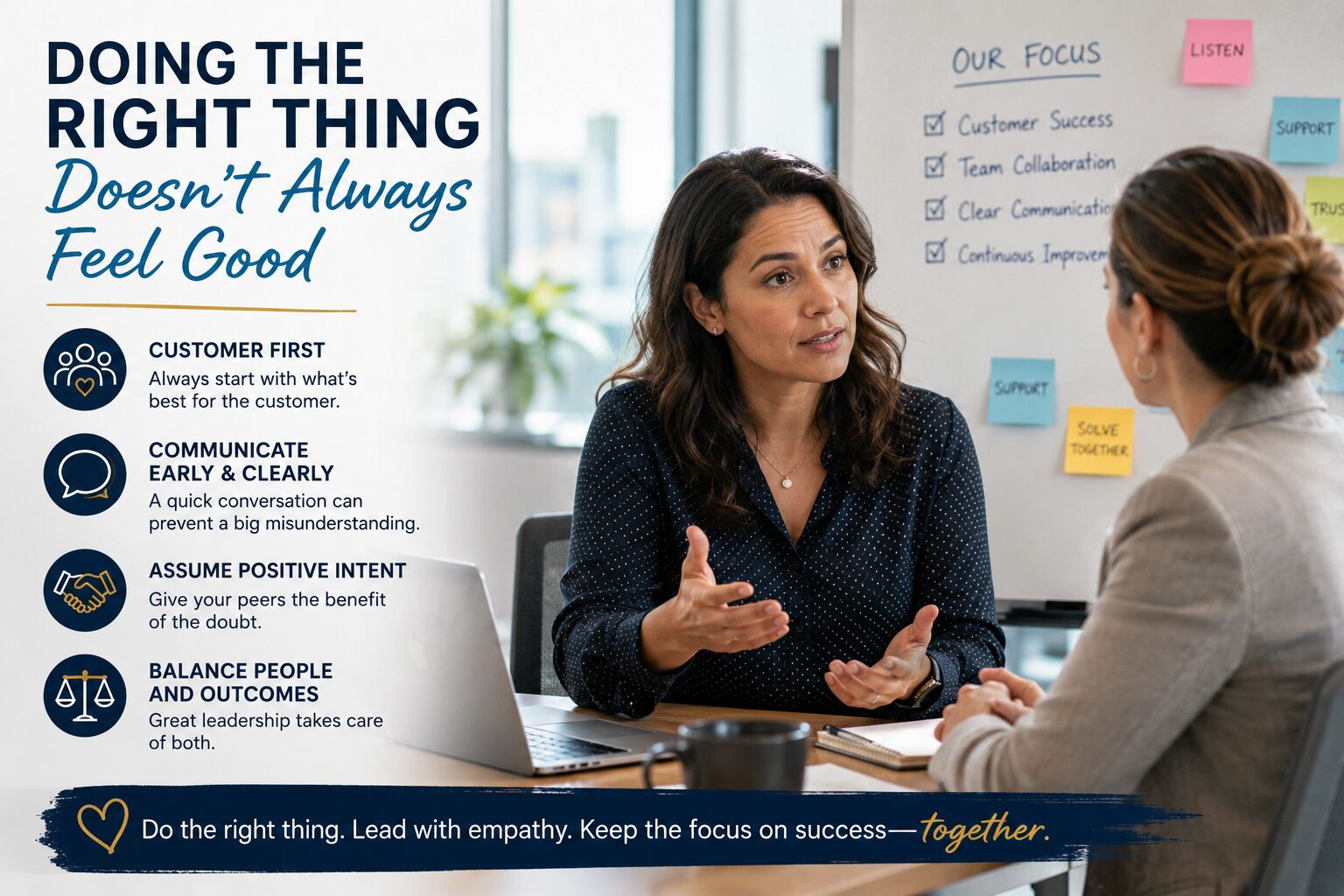
Have you ever done what was best for the customer and still ended up in an uncomfortable conversation with a colleague?
One of the hardest lessons I’ve learned as a Project Manager is that doing the right thing doesn’t always result in everyone being happy.
We often talk about managing stakeholders, budgets, risks, and timelines. What we don’t talk about enough is managing the emotions and perceptions of our peers when situations become uncomfortable.
Recently, I reflected on a scenario that many project professionals have likely encountered.
A customer reached out because they felt their project was drifting off track. They weren’t getting the communication they expected and were becoming concerned about the status of their implementation.
As project professionals, our first responsibility is to the success of the customer and the project. So I stepped in to help.
I gathered information, started addressing the customer’s concerns, and informed my manager that I was temporarily assisting to help get things moving in the right direction.
From my perspective, it was straightforward. A customer needed support, and I was available to help.
However, the reaction I received wasn’t what I expected.
The Project Manager assigned to the customer felt frustrated. They believed I should have discussed the situation with them first before involving management. They also interpreted the inclusion of their manager on communications as a sign that I was upset with them or escalating concerns about their performance.
That wasn’t my intent at all.
And that’s where the real lesson begins.
Intent and Impact Are Not Always the Same
One of the realities of leadership is that people experience situations through their own lens.
You may be focused entirely on solving a customer problem.
Someone else may see the same action as criticism.
You may view management visibility as transparency.
Someone else may view it as escalation.
Neither perspective necessarily comes from bad intentions.
The challenge is recognizing that while we control our intent, we don’t control how our actions are interpreted.
Put the Customer First, But Don’t Forget the Relationship
I still believe helping the customer was the right decision.
If a customer is struggling and you have the ability to help, stepping in is often the right thing to do.
But I’ve also learned that helping the customer and maintaining peer relationships are not mutually exclusive.
Whenever possible:
- Inform your colleague before stepping in.
- Frame your involvement as support, not rescue.
- Make it clear that your goal is customer success, not ownership transfer.
- Assume positive intent from your peer.
A simple conversation can prevent a lot of misunderstanding.
Don’t Let Defensiveness Drive Decisions
When someone becomes upset, there can be a temptation to defend yourself.
“I was just helping.”
“The customer contacted me.”
“I did nothing wrong.”
While those statements may be true, they rarely resolve the underlying issue.
Instead, I try to understand what concern is actually being expressed.
Often the real message isn’t:
“You shouldn’t have helped.”
It’s:
“I wish I had known.”
Or:
“I felt blindsided.”
Or:
“I’m worried about how this reflects on me.”
Understanding that difference changes the conversation completely.
Leadership Is Bigger Than Being Right
As project managers, we are often asked to make decisions in ambiguous situations.
Sometimes we have to act quickly.
Sometimes we have incomplete information.
Sometimes we do the right thing and still end up managing hurt feelings afterward.
That’s part of leadership.
Success isn’t measured solely by whether you were technically correct.
It’s measured by whether you helped the customer, strengthened the team, and preserved trust along the way.
One Last Thing…
There will be moments in your career when you step in to solve a problem because it is the right thing to do.
Not everyone will appreciate it.
Not everyone will interpret it the way you intended.
That doesn’t mean you made the wrong decision.
It simply means that leadership requires balancing two responsibilities at the same time:
Taking care of the customer.
And taking care of the people around you.
The best project managers learn how to do both.