
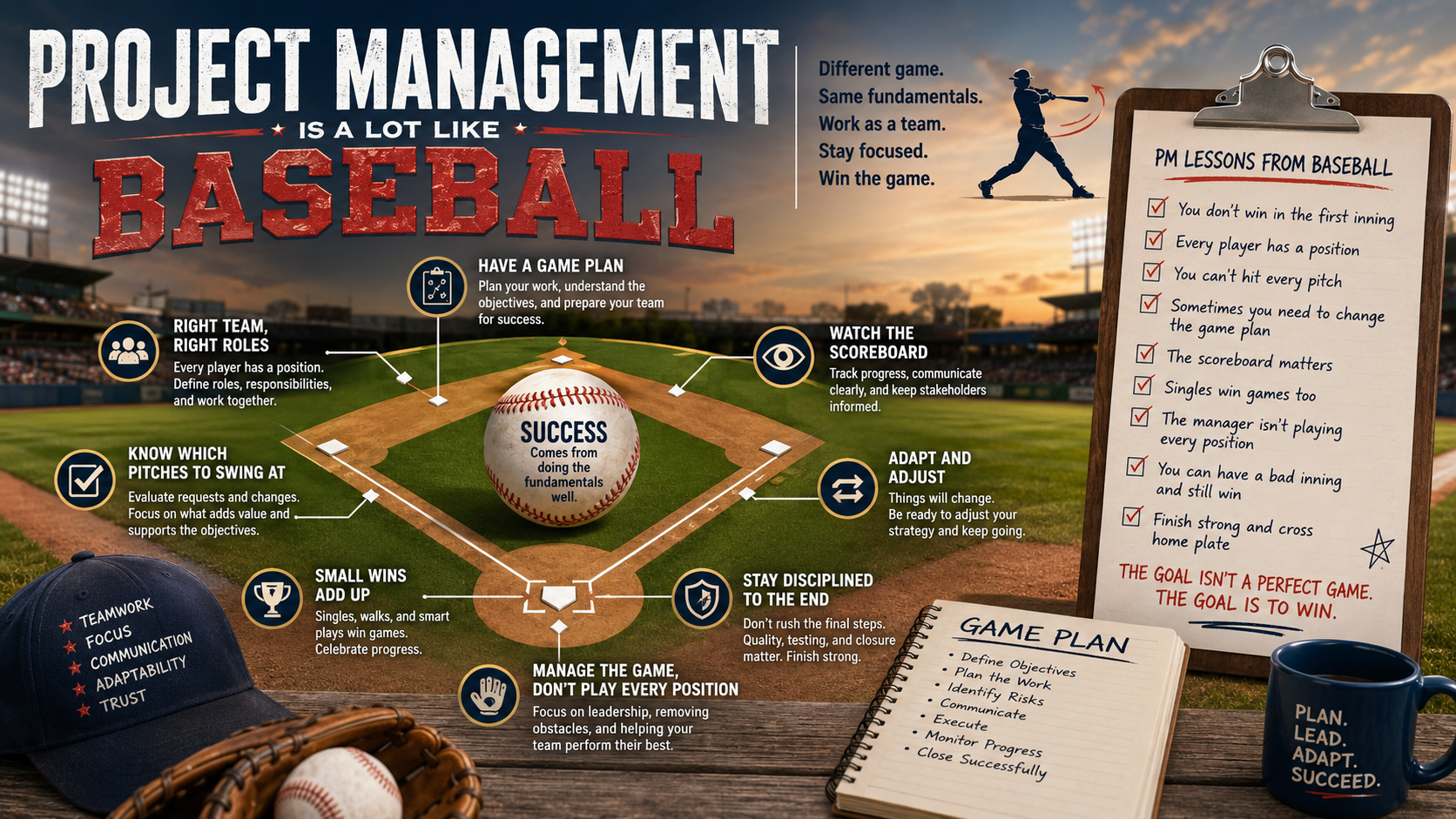
My son started playing baseball over the summer, and this got me thinking…. At first glance, project management and baseball might not seem to have much in common.
One involves schedules, budgets, risks, stakeholders, requirements, and status reports. The other involves bats, gloves, bases, and a scoreboard.
But spend enough time managing projects and watching baseball, and the similarities become pretty obvious.
Project management is a lot like baseball.
Both are team sports. Both require preparation. Both involve adapting to changing conditions. And in both, success rarely comes from one spectacular moment. It comes from consistently doing the fundamentals well.
You Don’t Win the Game in the First Inning
One of the biggest lessons baseball teaches us is patience.
A team doesn’t need to score five runs in the first inning. It needs to keep playing the game.
Projects are much the same.
At the beginning of a project, there can be a lot of excitement. Everyone wants to get started. Stakeholders want to see progress. Teams want to start building.
But good project managers understand that the early innings are about establishing a foundation.
You need to understand the requirements, align stakeholders, build the plan, identify risks, establish roles, and make sure everyone understands what success looks like.
You don’t have to win the project on Day One. You just need to put yourself in a position to win.
Every Player Has a Position
A baseball team doesn’t put nine shortstops on the field.
Each player has a role.
The same is true on a project team.
Project managers coordinate. Business analysts uncover and clarify needs. Developers build. Testers validate. Subject matter experts provide knowledge. Customers provide direction and feedback.
The best teams understand their responsibilities while also understanding how their roles connect to everyone else’s.
That’s why things like RACI charts, clear ownership, communication plans, and defined responsibilities matter.
If everyone assumes someone else is covering first base, eventually the ball is going to get through.
You Can’t Hit Every Pitch
Baseball players don’t swing at every pitch.
They watch. They assess. They decide.
Project managers need to do the same thing.
New requests will come in.
“Can we just add this?”
“Would it be possible to change that?”
“While we’re doing this, could we also…”
Not every request is bad. Some are genuinely valuable.
But every request needs to be evaluated.
Does it support the project objectives?
What impact will it have on schedule, cost, resources, or quality?
What happens if we don’t do it?
Good project management isn’t about saying no. It’s about knowing which pitches to swing at.
Sometimes You Need to Change the Game Plan
Even the best baseball team doesn’t know exactly what will happen once the game begins.
The pitcher changes strategy.
The opposing team makes adjustments.
The weather changes.
A player gets injured.
Projects are no different.
A customer changes their requirements. A dependency slips. A resource becomes unavailable. A technical issue appears. A new business priority suddenly takes over.
This is where a project plan becomes more than a document.
A good plan provides direction, but a good project manager knows when to adjust it.
The plan is not the project. The plan is the strategy for navigating the project.
The Scoreboard Matters
Baseball has a scoreboard.
Everyone can see the score.
Projects need a scoreboard too.
That’s where status reporting, dashboards, KPIs, milestones, risks, issues, and other project metrics come in.
Stakeholders shouldn’t have to ask:
“How are we doing?”
A good project manager should be able to show them.
Are we on schedule?
Are we within budget?
Are the major risks under control?
Are key milestones being achieved?
Are decisions being made?
Are we moving toward the outcome the customer actually needs?
If you can’t see the score, it’s difficult to know whether you’re winning.
The Home Run Gets the Attention — But Singles Win Games Too
We tend to celebrate the big moments: the home run, the game-winning hit, or a spectacular catch. But baseball games are also won through singles, walks, stolen bases, good pitching, smart decisions, and consistent execution. Projects work the same way.
Sometimes progress is a major milestone delivered ahead of schedule.
Other times it’s much less glamorous:
- Closing a long-standing issue
- Getting a stakeholder decision
- Completing a difficult requirements session
- Removing a dependency
- Finishing testing
- Clarifying a misunderstood requirement
- Getting the right people in the room
Those small wins add up.
Don’t underestimate the value of steady progress.
The Manager Isn’t Playing Every Position
A baseball manager doesn’t run onto the field and try to play every position.
They manage the game.
They watch what’s happening. They make decisions. They communicate with the team. They determine when adjustments are needed.
Project managers need to think the same way.
It’s tempting to jump in and do everything.
Write the requirements.
Build the spreadsheet.
Run the testing.
Fix the issue.
Create the presentation.
Send every email.
But if the project manager becomes the person doing everyone’s job, they’re no longer managing the game.
The PM’s value often comes from seeing the bigger picture, connecting the pieces, removing obstacles, and helping the team perform at its best.
Sometimes You Lose an Inning
Here’s another important lesson from baseball:
You can have a bad inning and still win the game.
Projects can have bad days too.
A milestone slips.
A defect appears.
A customer isn’t happy.
A dependency fails.
A decision takes longer than expected.
The important question isn’t:
“Did something go wrong?”
Something will eventually go wrong.
The better question is:
“What are we going to do about it?”
Strong project teams don’t spend all their energy assigning blame.
They assess what happened, learn from it, adjust the plan, and get back in the game.
And Then There’s the Ninth Inning
As a project gets closer to completion, the pressure can increase.
Everyone wants to cross the finish line.
But this is exactly when project teams need to stay disciplined.
Don’t rush testing.
Don’t skip documentation.
Don’t ignore outstanding risks.
Don’t assume everything will magically work because the deadline is tomorrow.
The final stretch matters.
A project isn’t successful because you reached the ninth inning.
It’s successful when you actually get across home plate.
The Bottom Line
Project management isn’t about having a perfect plan.
It’s about building a capable team, understanding the objective, communicating clearly, watching the scoreboard, managing the risks, making good decisions, and adapting when the game changes.
Just like baseball, projects are rarely won by one person.
They’re won by a team.
And just like baseball, you don’t need to hit a home run every time you step up to the plate.
Sometimes you just need to get on base.
Keep moving the runners. Keep watching the scoreboard. Keep adjusting your strategy. And keep playing the game.
Because in project management, just like baseball…
The goal isn’t to have a perfect game. The goal is to win (or, as I tell my kid, just have fun)