
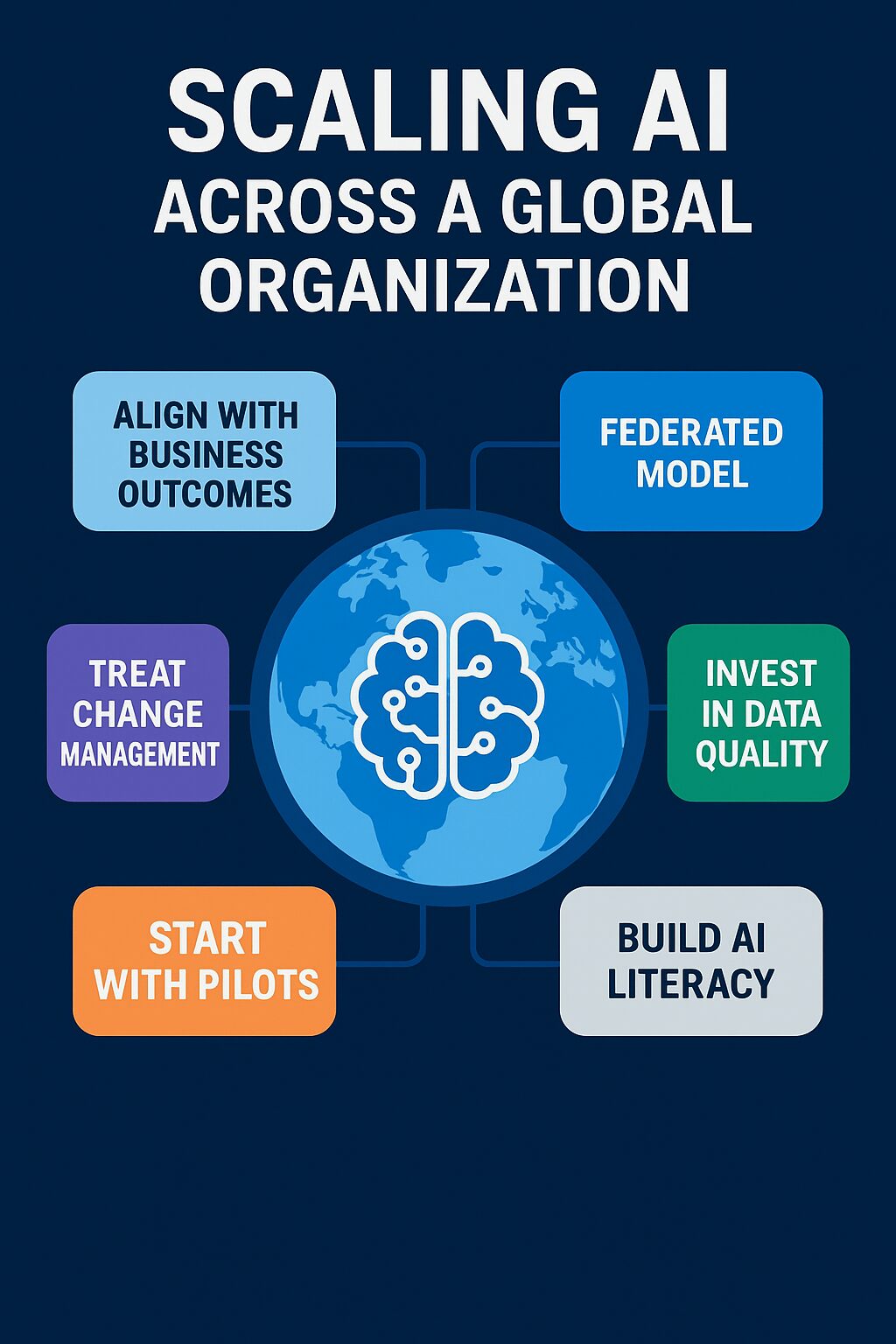
Scaling AI isn’t a single project — it’s a programmatic capability. You’re moving from isolated pilots to consistent, measurable, organization-wide value. Here’s how global companies do it:
1️⃣ Start with a Clear Strategy and Business Alignment
Before scaling AI, you need clarity on:
- What business problems AI should solve
- Which outcomes matter most (efficiency, risk reduction, customer experience, revenue)
- How AI aligns with the organization’s mission and long-term roadmap
A strong AI strategy provides the “north star” that guides all teams worldwide.
2️⃣ Build a Federated but Coordinated Governance Model
Global scaling requires balance:
Centralized direction + decentralized execution.
Typically this looks like:
- A central AI/ML or Digital Transformation team setting standards, tools, ethics, and governance
- Regional/business-unit teams implementing AI based on local needs
- Shared oversight to ensure compliance, consistency, and integration
This model enables speed without chaos.
3️⃣ Invest in Data Quality and Infrastructure Early
AI cannot scale on messy or inconsistent data.
Global scaling requires:
- Standardized data definitions
- Central data platforms (lakes/warehouses)
- Secure and compliant data access
- Data architecture that supports real-time or near-real-time use
Data maturity is often the single biggest barrier to scaling AI.
4️⃣ Build a Skilled Internal Workforce
AI adoption accelerates when people know how to use it confidently.
This means:
- AI literacy training for all employees
- Role-specific upskilling (PMs, BAs, developers, analysts, leaders)
- Advanced AI/ML training for technical teams
- Internal communities of practice or AI champions
You don’t scale AI by hiring more experts — you scale it by empowering your whole organization.
5️⃣ Develop Reusable AI Components, Models, and Playbooks
Don’t reinvent the wheel across regions.
Instead, create:
- Reusable workflows (e.g., onboarding, support, document analysis)
- Standard APIs, templates, and best practices
- Model “starter kits” for common use cases
- Shared libraries for agents, automations, and insights
This reduces time-to-value and ensures consistency.
6️⃣ Build AI Governance That Includes Ethics and Risk
Global organizations must navigate:
- Privacy laws across countries
- Compliance and auditability
- Bias and fairness concerns
- Explainability requirements
Strong governance ensures AI is scaled responsibly, safely, and sustainably.
7️⃣ Start with High-Value Pilots — Then Scale
Instead of spreading efforts thin, successful organizations:
- Identify high-impact, cross-regional use cases
- Pilot in one area
- Measure results and ROI
- Then scale horizontally across teams or countries
This creates momentum and confidence across the global workforce.
8️⃣ Make Change Management a Core Part of the Strategy
Scaling AI is as much cultural as it is technical.
To succeed:
- Communicate transparently about the purpose of AI
- Address fears, misconceptions, or resistance
- Co-design solutions with end users
- Celebrate quick wins and share success stories globally
Without strong change management, even the best AI solutions fail to get adopted.
9️⃣ Adopt the Right Tools: Secure, Scalable, and Enterprise-Ready
Global scaling requires:
- Enterprise-grade AI platforms
- API-based architecture
- Security, logging, and auditing
- Support for multilingual use cases
- Integration with existing global systems
Choose tools that scale with you — not ones you outgrow.
🔟 Measure, Iterate, Repeat
Scaling AI is an ongoing cycle:
- Measure productivity, cost savings, accuracy, and user adoption
- Learn from pilots
- Continuously improve data, models, workflows, and processes
Global AI maturity grows iteration by iteration.
🚀 Final Thought
Scaling AI across a global organization is not about pushing technology everywhere at once — it’s about building the conditions where AI can thrive anywhere.
With the right strategy, governance, talent, data foundation, and change management, AI becomes not just a tool, but a core capability embedded in how the organization operates worldwide.